March 2026 • 8 min read
──────────────
At a Glance
How does diet affect jaw development and your ability to breathe freely?
Modern soft-food diets deprive the jaw of the mechanical stress it needs to develop fully, leading to narrower palates, more crowded teeth, and reduced nasal airway space. This pattern, documented in skulls spanning nearly 1,000 years of human history, accelerated sharply after the Industrial Revolution. Restoring regular chewing of hard, fibrous foods is one of the simplest structural interventions available, and it requires no equipment, no supplements, and no specialist.
──────────────
In this article, you’ll discover:
- Why brachycephalic dog breeds hold an uncomfortable mirror up to modern humans
- What nearly 1,000 years of human skulls reveal about jaw development and diet
- The biological law that explains why your jaw stops growing when you stop chewing
- The best hard foods for structural airway support—backed by anthropological evidence
- A single, actionable dietary shift you can make starting today
──────────────
Table of Contents
The Dog That Can’t Breathe Easily
A Skull Collection That Changed Everything
- Wolff’s Law: The Biology of Use It or Lose It
Weston A. Price and One Generation of Evidence
What Soft Food Actually Costs Your Airway
Foods That Work Your Jaw (And Support Your Airway)
One Small Shift Starting Today
Key Takeaways
Frequently Asked Questions
Conclusion
Related Articles
References
──────────────
Look at a French Bulldog.
That flat face. The pushed-in nose. The snoring that never stops, even in deep sleep. Owners find it endearing. Veterinarians find it heartbreaking, because that dog is working hard, every single minute of its life, just to breathe.
Here is the uncomfortable question: what if we are doing something similar to ourselves, just more slowly, and with a fork?
The Dog That Can’t Breathe Easily
Brachycephalic breeds: French Bulldogs, Pugs, English Bulldogs, were selectively compressed over generations of breeding.¹ Smaller snout. Narrower nostrils. Reduced oral cavity. The result is a structurally compromised airway that no amount of veterinary care can fully reverse.
The compression was deliberate. The breathing problem was a side effect nobody planned for.
For most modern humans, the process is neither deliberate nor dramatic. It is simply a diet: soft, processed, industrially engineered food, quietly doing over decades what selective breeding did to the bulldog over generations.
The mechanism is real, measurable, and well-documented in both anthropology and orthodontics. And if it feels abstract, the simplest place to start understanding it is in a basement in Philadelphia.²
If you want a broader picture of how your breathing habits reflect your overall health, Spotting Your Breathing Habits: A Complete Guide to Conscious Breath Awareness is a useful starting point.
A Skull Collection That Changed Everything
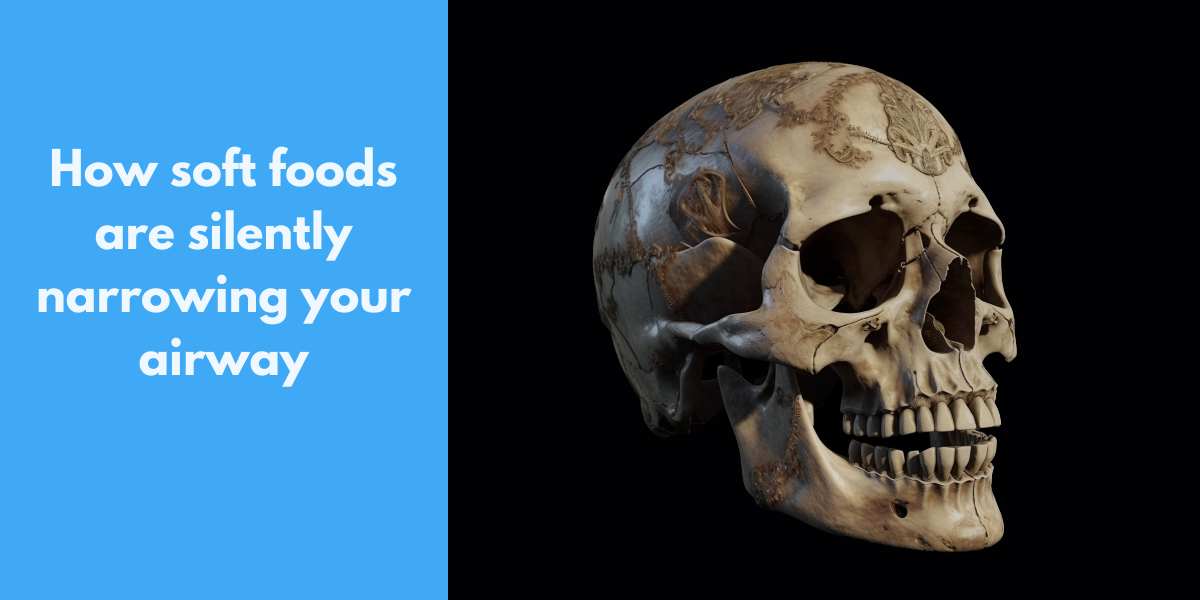
In the basement of the University of Pennsylvania, there is a collection of skulls spanning nearly 1,000 years of human history.
Researcher and journalist James Nestor examined this collection while writing his book Breath.² What he found was not subtle. The further back in time, the larger the jaw, the wider the palate, the more forward the facial structure. The more recent the skull, the narrower the arch, the more crowded the teeth, the smaller the oral cavity.
The shift accelerates sharply after the Industrial Revolution.
This is not primarily a genetic story. The genome of Homo sapiens has not meaningfully changed in hundreds of years. The skulls in that collection all belong to the same species. What changed was what those skulls were chewing, and how hard.
Wolff’s Law: The Biology of Use It or Lose It
The mechanism behind Nestor’s skull findings is Wolff’s Law: a foundational principle in orthopedic science, first articulated by German anatomist Julius Wolff in 1892.³ The principle is straightforward: bone remodels in response to the mechanical stress placed upon it. Apply force repeatedly, and the bone grows stronger and denser in that direction. Remove the force, and the bone gradually adapts by doing less.
Chewing is mechanical stress. The right kind. The kind that signals the jaw to grow wide, the palate to expand, and the nasal cavity to open upward and forward. Researchers studying craniofacial development confirm that masticatory loading, the physical force of chewing, is a primary driver of jaw and palate morphology across primate species.⁴
When that stress disappears, the signal disappears. The jaw stops receiving its developmental cue. The airway narrows quietly, over the years, without anyone noticing until the dentist mentions crowded teeth or the ENT mentions a narrow nasal passage.
Weston A. Price and One Generation of Evidence
In the 1930s, dentist Dr. Weston A. Price traveled to fourteen isolated indigenous communities across four continents. He was looking for the cause of dental crowding, crooked teeth, and narrow arches that were rapidly becoming epidemic in Western cities.⁵
What he found was striking. In every community still eating their traditional diet: tough, fibrous, unprocessed food requiring real chewing force, jaw structure was broad, teeth were straight, and airways were open. The same communities that adopted imported refined foods within a single generation produced children with dramatically different craniofacial structure: narrowed palates, crowded dentition, and the same compression Price was seeing in Western patients.
Same genetic line. Same family. One generation. Different jaw.
Price’s nutritional theories have been debated and partially revised since his time. But his observations about changing jaw structure, the morphological transition that accompanies dietary shift, are widely cited in orthodontic anthropology and continue to inform research into malocclusion epidemiology.⁶
What Soft Food Actually Costs Your Airway
Look at a typical modern meal.
Bread that dissolves. Rice soft-cooked to mush. Packaged snacks engineered to melt in the mouth. Smoothies that replace meals entirely. Each of these is a food product optimized for palatability and convenience, not for the mechanical work it demands from your jaw.
Every bite that requires no real chewing effort is a missed developmental signal. This matters most during childhood and adolescence, when craniofacial structures are still actively forming. But adult bone remains responsive to mechanical loading throughout life. Wolff’s Law does not expire at eighteen.³
The downstream consequences are not just cosmetic. A narrowed palate means a narrowed nasal cavity, the primary airway for nose breathing, which filters, warms, and humidifies incoming air in ways that mouth breathing cannot replicate. A reduced nasal airway increases resistance, promotes mouth breathing, and sets the stage for the kind of disrupted nighttime breathing that millions of people now treat with CPAP machines. without ever examining the structural cause.²
The connection between jaw structure and nasal function is explored in more detail in The Hidden Science of Nostril Breathing: How Your Nose Controls Your Brain Function.
Foods That Work Your Jaw (And Support Your Airway)
If chewing helped shape the airway in the first place, then restoring chewing is one of the simplest structural interventions available. No equipment. No specialist. No supplements.
These are some of the most effective naturally hard foods, that require real masticatory effort, support dental and jaw structure, and in doing so, protect the airway:
- Raw carrots — dense, fibrous, and one of the best everyday jaw workouts available. Rich in beta-carotene and Vitamin A, which support mucosal health in the nasal and throat lining.
- Whole apples — biting into a whole apple applies lateral force across the entire jaw arch. Far more effective than apple juice, which delivers sugar without a single chewing demand.
- Almonds and walnuts — require sustained chewing, stimulate saliva production, and deliver magnesium and omega-3 fatty acids that support breathing muscle function.
- Raw broccoli and cauliflower — crunchy, fibrous, and anti-inflammatory. Regular chewing of dense vegetables maintains masticatory muscle tone over time.
- Whole grains in unrefined form — oats, barley, whole wheat berries, or any grain eaten close to its natural state rather than milled into flour. Traditional populations who ate whole, unprocessed grains consistently showed broader jaw development in Price’s field research.⁵
- Tough cuts of meat and dried proteins — slow-cooked bone-in meats, jerky, or sun-dried proteins common across traditional cultures require full jaw engagement and sustained chewing effort.
- Sugarcane — widely available across tropical and subtropical regions, sugarcane is one of the most demanding jaw exercises that exists naturally. Traditional populations who chewed sugarcane regularly have been documented with wider palate morphology in anthropological surveys.
None of these foods are exotic or expensive. They are, almost without exception, less processed than the alternatives they replace.
One Small Shift Starting Today
You do not need to overhaul your diet overnight. The structural impact of chewing accumulates over weeks, months, and years. The same logic applies in reverse: the damage from a soft-food diet did not happen in a week, and the recovery will not either.
But the direction of change can begin today.
- Start with one meal. One snack. One choice.
- Swap the smoothie for a whole fruit. Same nutrients, with 100 percent more jaw engagement.
- Choose raw over cooked where you can. A raw carrot delivers a structural benefit that a cooked carrot cannot.
- Reach for an apple instead of a biscuit. Same hand movement, completely different signal to your jaw.
- Eat your salad before it’s blended. Whole leaves over liquid greens, every time you have a choice.
Every bite you actually have to chew is a small act of structural maintenance: for your jaw, your palate, your nasal airway, and ultimately, your breath.
If you’re also interested in how breathing mechanics interact with daily energy and fatigue, The Breath-Energy Connection: Powerful Ways to Boost Your Natural Vitality
The French Bulldog cannot change what breeding did to its face. You are still in conversation with your biology. And your biology is listening.
──────────────
Key Takeaways
- Modern soft-food diets deprive the jaw of the mechanical loading it needs to develop fully, leading to narrower palates, crowded teeth, and reduced nasal airway space.
- Skull evidence spanning nearly 1,000 years of human history shows a clear structural shift that accelerates sharply after the Industrial Revolution; this is diet, not genetics.
- Wolff’s Law confirms that bone remodels in response to mechanical stress. Chewing is that stress. Remove it, and the jaw stops receiving its developmental signal.
- A narrowed palate reduces nasal cavity volume, compromising the primary breathing airway and increasing the risk of mouth breathing and related health consequences.
- Hard, fibrous foods: raw carrots, whole apples, nuts, raw vegetables, whole grains, tough meats, restore masticatory demand and provide structural support for jaw and airway health.
──────────────
Frequently Asked Questions
Can adults improve jaw development through diet, or is it too late?
Adult bone remains responsive to mechanical loading throughout life—Wolff’s Law does not have an age cutoff. While the most dramatic structural development occurs in childhood and adolescence, consistent masticatory loading in adulthood can maintain bone density, support masticatory muscle tone, and slow the structural narrowing associated with soft diets. It is never too late to restore chewing demand.
Does mouth breathing cause jaw narrowing, or does jaw narrowing cause mouth breathing?
Both are true, and they form a feedback loop. Narrowing of the nasal airway, partly caused by reduced jaw development, makes nasal breathing harder and encourages mouth breathing. Chronic mouth breathing, in turn, changes resting tongue posture and facial muscle tone in ways that further influence jaw and palate development. The two processes reinforce each other, which is why addressing diet and chewing habits matters at any age.
Are chewing exercises or jaw trainers a useful supplement?
Dedicated jaw trainers and chewing gum tools do exist, and some orthodontists recommend them in specific clinical contexts. But the evidence base for dietary change, returning to naturally hard, fibrous whole foods, is far more robust and covers far more of the developmental picture. Real food provides the mechanical load in the context of nutrition, which makes it a more complete intervention.
What does all of this have to do with breathing at night?
A narrow palate reduces nasal cavity volume, which increases airway resistance during sleep. This is a recognized pathway to snoring, upper airway resistance syndrome, and obstructive sleep apnea. Most treatment protocols address the symptoms (CPAP, surgery) rather than the structural root cause. Dietary changes that support jaw and palate development address the structure directly, though they take months to years rather than immediate effect.
Were traditional diets better for jaw development simply because they had less sugar?
Sugar is relevant to dental decay and metabolic health, but the structural argument is primarily about mechanical demand, not sugar content. A low-sugar diet of entirely soft, processed food would still fail to provide the chewing force needed for jaw development. The key variable is food texture and resistance; how hard it is to break down. Traditional whole foods scored high on that measure almost regardless of their macronutrient composition.
Is this related to why so many children need orthodontic work today?
Yes, this is precisely the connection that dental anthropologists have been documenting for decades. The epidemic of crowded teeth and malocclusion in industrialized populations is not primarily genetic. Research going back to Corruccini in the 1980s, and extending to more recent craniofacial anthropology, points consistently to soft dietary texture as the primary driver of the structural change.⁶
──────────────
Conclusion
The French Bulldog’s breathing problem was engineered deliberately, a consequence of selective breeding that compressed the airway in pursuit of a particular aesthetic. Nobody intended to create an animal that struggles to breathe.
The modern human’s version of that story is less visible but structurally similar. Industrial food processing removed the mechanical challenge from eating. The jaw, following Wolff’s Law as it always has, adapted by doing less. And the airway quietly narrowed.
The reversal is not complicated. It requires no specialist, no surgery, no device. It requires choosing, at some meals, food that pushes back a little.
Your jaw is still in conversation with what you put in your mouth. So is your airway. The foods that served that structure for most of human history are still available. The question is simply whether you reach for them.
──────────────
Related Articles
Nose Breathing vs Mouth Breathing: Why Your Breathing Technique Matters
The Hidden Science of Nostril Breathing: How Your Nose Controls Your Brain Function
Spotting Your Breathing Habits: A Complete Guide to Conscious Breath Awareness
The Breath-Energy Connection: Powerful Ways to Boost Your Natural Vitality
──────────────
References
- Packer, R. M., Hendricks, A., & Burn, C. C. (2012). Do dog owners perceive the clinical signs related to conformational inherited disorders as ‘normal’ for the breed? A potential constraint to improving canine welfare. Animal Welfare, 21(S1), 81–93. https://www.researchgate.net/publication/225280218_Do_dog_owners_perceive_the_clinical_signs_related_to_conformational_inherited_disorders_as_'normal'_for_the_breed_A_potential_constraint_to_improving_canine_welfare
- Nestor, J. (2020). Breath: The new science of a lost art. Riverhead Books.
- Wolff, J. (1892). Das Gesetz der Transformation der Knochen. Hirschwald. [Reprinted and translated as: Wolff, J. (1986). The law of bone remodelling. Springer-Verlag.]
- Lieberman, D. E., Krovitz, G. E., Yates, F. W., Devlin, M., & St. Claire, M. (2004). Effects of food processing on masticatory strain and craniofacial growth in a retrognathic face. Journal of Human Evolution, 46(6), 655–677. https://doi.org/10.1016/j.jhevol.2004.03.005
- Price, W. A. (1939). Nutrition and physical degeneration. Paul B. Hoeber. [8th ed. reprinted by Price-Pottenger Nutrition Foundation, 2008.]
- Corruccini, R. S. (1984). An epidemiologic transition in dental occlusion in world populations. American Journal of Orthodontics, 86(5), 419–426. https://doi.org/10.1016/S0002-9416(84)90035-6
──────────────
About the Author
Written by Sowmiya Sree | Breath Researcher & Author
This article is thoroughly researched and fact-checked using peer-reviewed studies and trusted medical resources.
Last updated: March 2026
──────────────
Medical Disclaimer
This article is for informational purposes only and does not constitute medical advice. The relationship between diet, jaw development, and airway health is an active area of research; individual outcomes vary significantly. If you have concerns about jaw structure, nasal airway obstruction, or sleep-disordered breathing, consult a qualified healthcare professional or specialist. Do not use this article to self-diagnose or self-treat any medical condition.
Photo by guilhermestocks on Canva