Blog

Emotional Illiteracy: Why You Can’t Regulate What You Can’t Name (And How

Reading Time: 8 min read

At a Glance

Why is it so hard to regulate emotions you can’t identify? You cannot regulate what you cannot name. Every emotion has a distinct physiological signature; anger, fear, sadness, and shame each activate different nervous system patterns in the body before the mind registers them. DBT (Dialectical Behavior Therapy) provides evidence-based regulation skills, but breath-based body awareness is the access point that makes those skills reachable even when you’re...

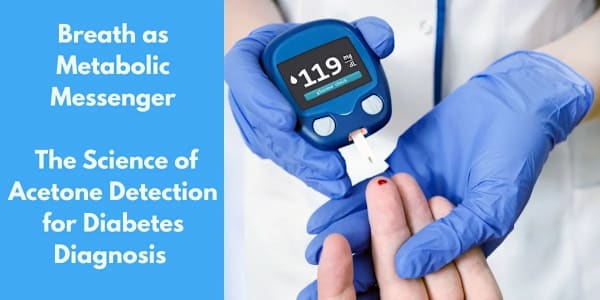
Breath as Metabolic Messenger: The Science of Acetone Detection for

5 min read

At a Glance

How does breath acetone detection work for non-invasive diabetes diagnosis, and when will this technology be available in consumer devices?

Breath acetone detection identifies diabetes by measuring acetone levels in exhaled breath. Healthy individuals exhale 300-900 parts per billion (ppb) of acetone, while diabetic individuals exhale 900-1,800 ppb due to increased fat metabolism when cells can't effectively use glucose.

A breakthrough sensor developed at Penn State...

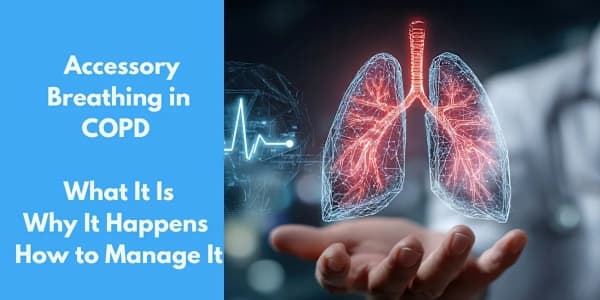
 Accessory Breathing in COPD: What It Is, Why It Happens, and How to Manage

Read time: 8 minutes

When you can't catch your breath, your body doesn't ask permission to adapt.

It recruits backup. It pulls in help from muscles that were never meant to breathe full-time. And for people living with chronic obstructive pulmonary disease (COPD), this adaptation becomes a daily reality.

This is accessory muscle breathing, when your neck, shoulders, and upper chest take over the work your diaphragm can no longer handle alone.

If you've noticed your shoulders rising with every...

The 90-Second Rule: Why Your Anger Lasts Hours (And How to Actually Stop

Yesterday, someone cut me off in traffic.

A stupid, minor thing. They merged without looking. I had to brake hard.

And I was furious for the next three hours.

I replayed it while making lunch. Imagined what I should have yelled. Pictured myself following them just to... I don't know, glare at them at the next light?

Then I remembered something I'd read from Dr. Jill Bolte Taylor, a Harvard-trained neuroanatomist who discovered something shocking about emotions:

The physiological lifespan of...

Why Resolutions Fail: The 1-Minute Morning Breath Ritual for Nervous System

Research published in the Journal of Clinical Psychology found that while 46% of people maintain resolutions for six months, the drop-off is steep—nearly one-third of all failures happen before the end of January².

But here's what the research doesn't tell you: the problem isn't your willpower. It's your nervous system.

Your body doesn't recognize January 1st as a reset. Your nervous system doesn't care about resolutions, meal prep plans, or gym memberships.

It responds to one signal louder...

Why Winter Air Makes Breathing Harder (And How to Breathe Easier) I stepped

I stepped outside this morning, and immediately when I exhaled, small clouds of vapor rose into the cold air.

It's always fun to watch that, isn't it? There's something almost magical about seeing your breath materialize in front of you, a reminder that winter has truly arrived.

We've all seen those vapor clouds since childhood. We've made dragon breath jokes, tried to blow the biggest clouds, and watched them dissipate into the morning air. But here's what nobody tells you about visible...

Why Stress Eating Hurts Your Gut: How the Vagus Nerve and Breathing Affect

Last Thursday, I ate way too much.

You know the feeling, that post-Thanksgiving food coma where you're sprawled on the couch, pants unbuttoned, wondering why you went back for thirds.

But here's what got me thinking: why does stress eating feel different from relaxed eating?

Same food. Same stomach. But somehow, when you're anxious or rushed, your digestion goes haywire. Bloating, discomfort, that heavy brick-in-your-stomach feeling.

Turns out, there's actual science behind this. And it all...

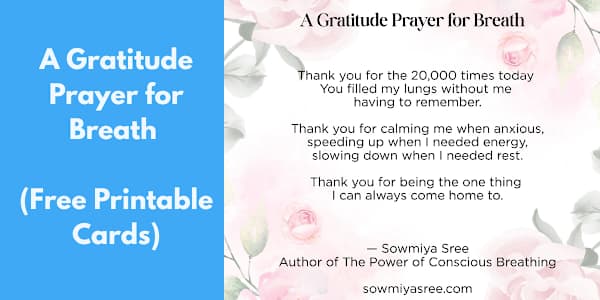
A Gratitude Prayer for Breath (Free Printable Cards) Last night, as I sat

Last night, as I sat down to write this, I took a breath. Just one. And I realized something: I'd taken about 20,000 breaths that day without thinking about a single one.

When was the last time you said thank you to your breath?

This Thanksgiving week, as tables fill with food and homes fill with people, I wanted to pause and say thank you, not just to the people around us, but to the one companion that's been with us every single moment of our lives.

Your breath.

The invisible force that asks...

Why Do Couples Breathe in Sync? The Science of Physiological Synchrony

Yesterday morning, I hummed a tune while making coffee. My husband stopped and said, “I was literally just thinking of that song.” We both smiled. How does that even happen?

Turns out, it’s not just thoughts that sync up, your breath does too.

This invisible connection is called physiological synchrony, and it’s changing how scientists understand relationships.


Quick 5-Point Summary

  • Breath synchrony: how couples' breathing naturally aligns
  • Physiological synchrony explained by scientific studies
  • ...
What Does Shortness of Breath on Stairs Mean? Usain Bolt gets winded

Usain Bolt gets winded climbing stairs.

Let that sink in for a second.

The fastest human who ever lived. The man who ran 100 meters in 9.58 seconds. Eight Olympic gold medals. The guy who made speed look effortless.

He recently admitted he struggles with breathlessness when climbing staircases since retirement.

If the world's most elite athlete loses his breath on everyday stairs, what does that say about the rest of us? And more importantly, what is our breath trying to tell us?

Quick 5-Point...

The 4-Step Altitude Breathing Method That Transforms Mountain Adventures

Estimated Reading Time: 6 minutes

Quick 5-Point Summary

  • Problem: Most people panic and fight their body's natural breathing response at altitude (8,000+ feet)
  • Solution: 4-4-6-2 breathing pattern (inhale 4, hold 4, exhale 6, pause 2) that works with your body's adaptation
  • Science: Your chemoreceptors naturally increase breathing 15-25% at altitude—this technique channels that response effectively
  • Training: Practice 10 minutes daily for 3-4 weeks before your mountain trip
  • Result:...
How Long Should Your Breathing Sessions Be? What This Neuroscientist

Estimated Reading Time: 6 minutes

Quick 5-Point Summary

  • One breath is enough- Dr. Sweta Adatia's brain scans prove a single Bhramari Pranayama breath increases focus waves by 1000% and boosts calming alpha waves
  • Simple technique - Sit straight, thumbs over ears, inhale deep, exhale with a hum for 30-60 seconds total
  • Quality over quantity - One conscious breath beats 30-minute mindless sessions every time
  • Anchor to habits - Link your daily breath to existing routines (morning coffee,...
Why Breathing Less Can Calm You More: The Science of CO2-Optimized

Table of Contents


What is CO2-Optimized Breathing?

The Scientific Discovery That Explains Why Extended Exhales Work

  • The CO2 Balance Revolution
  • The Bohr Effect Breakthrough
  • The 4:8 Technique Mechanism
  • The Extended Exhale Effect
  • The Ancient-Modern Connection

Best Practices for CO2-Optimized Breathing

Transform Your Stress Response Starting Today

Most people think they need to breathe deeply when stressed — but they're doing the exact opposite of what their body needs. A simple yoga instruction...

How Your Breathing Can Literally Reverse Cellular Aging Using Nobel Prize

Estimated Reading Time: 5 minutes


Quick Summary

Learn Nobel Prize science - how breathing literally reverses cellular aging at the chromosome level.

Master 5 proven techniques - science-backed ways to activate your body’s repair systems.

Get a simple daily practice - 4-6 breathing method that takes just 5 minutes for results.

Break the stress-aging cycle - understand how chronic stress damages cells, and breathing repairs them.

Join the cellular repair revolution - discover why leading experts...

Your Breathing Pattern Is as Unique as Your Fingerprint — And It Reveals

Estimated Reading Time: 6-8 minutes


Quick Summary


96.8% accuracy identifying people - more unique than voice recognition
Predicts anxiety, depression & BMI - from breathing patterns alone
Stable for 2+ years - your signature doesn't change
Monitor at home with apps - no expensive equipment needed
24/7 health scanning - works while you sleep
Early warning system - detects changes before symptoms


Table of Contents

Introduction

What Are Respiratory Fingerprints?

The 5 Game-Changing Discoveries About...

The Hidden Science of Nostril Breathing: How Your Nose Controls Your Brain

Estimated Reading Time: 6-8 minutes


Quick Summary

  • In average nasal cycle alternates every 2-4 hours - controls brain hemisphere activation
  • Right nostril breathing = left brain boost - enhances logical thinking & analysis
  • Left nostril breathing = right brain boost - increases creativity & intuition
  • Stress disrupts natural breathing patterns - causing mental fog & poor focus
  • Healthy nasal cycling = balanced nervous system - better mood & energy levels
  • Pranayama techniques...
4-4-8 vs 4-7-8 Breathing: Which Sleep Method Actually Works? ⏰Estimated

Estimated Reading Time: 4-5 minutes


Quick Summary

Two proven breathing techniques help you fall asleep faster: 4-4-8 (beginner) and 4-7-8 (advanced)

4-4-8 breathing is gentler for newcomers - inhale 4, hold 4, exhale 8 counts

4-7-8 breathing creates stronger relaxation - inhale 4, hold 7, exhale 8 counts

Both methods activate your parasympathetic nervous system for natural sleep induction

Most people see results within 2-4 breathing cycles, with full effects in 8-12 rounds

Start...

Understanding Breathing Rates Across Age Groups: A Comprehensive Guide

8 min. Estimated Reading time.

Introduction

Did you know that newborns breathe up to 60 times per minute — nearly four times faster than an adult man? This striking difference reveals just how much our respiratory patterns change throughout our lives. Understanding normal breathing rates isn’t just fascinating — it’s a crucial respiratory health monitoring skill that can provide peace of mind or alert you to potential breathing problems.

Breathing rates are often overlooked vital signs, yet...

Nose Breathing vs Mouth Breathing: Why Your Breathing Technique Matters Do

Do you know that up to 61% of adults breathe through their mouths instead of their noses? You might be one of them, unknowingly sabotaging your energy and focus with every breath you take.


8 min. Estimated Reading time.


Why Your Breathing Method Matters for Health and Energy?

Imagine this: you're sitting at your desk, struggling to focus on an important task. Your energy is low, your mind is foggy, and you can't figure out why. The answer might be right under your nose—literally.

Most of us...

The Weird 4-Second Trick That Eliminates Afternoon Fatigue Almost Instantly

8 min. Estimated time.


Introduction

Does your energy crash harder than the stock market around 3 PM every workday? You’re not alone—75% of office workers report experiencing significant afternoon energy dips that dramatically affect their productivity.

The afternoon slump isn’t just annoying—it costs businesses billions annually in lost productivity. But what if you could eliminate that fatigue without another cup of coffee or energy drink?

In this article, you’ll discover:

  • Why does afternoon...