Yesterday, someone cut me off in traffic.
A stupid, minor thing. They merged without looking. I had to brake hard.
And I was furious for the next three hours.
I replayed it while making lunch. Imagined what I should have yelled. Pictured myself following them just to... I don't know, glare at them at the next light?
Then I remembered something I'd read from Dr. Jill Bolte Taylor, a Harvard-trained neuroanatomist who discovered something shocking about emotions:
The physiological lifespan of an emotion in your body is 90 seconds.¹
90 seconds. That's it.
That's how long it takes for the chemical cascade—cortisol, adrenaline, norepinephrine—to flood your system, peak, and then naturally flush out.
So why was I still mentally road-raging three hours later?
Welcome to the anger loop. And the neuroscience that can actually break it.
In this article, you'll discover:
- Why emotions are designed to last only 90 seconds (and what goes wrong)
- The brain mechanism that keeps you stuck in anger for hours
- DBT skills that interrupt the emotional loop
- How specific breathing patterns accelerate emotional regulation
- A practical 2-minute technique to reset your nervous system
Table of Contents
──────────────
What is the 90-Second Rule? The Science Behind Emotional Lifespan
The Anger Loop: Why You're Stuck (And It's Not Your Fault)
What Happens in Your Body During the Anger Loop
What Actually Breaks the Cycle: Enter DBT Skills
- The Core Principle: Distress Tolerance
- The TIPP Technique: Your Physiological Circuit Breaker
The Missing Component That Makes DBT Work Faster: Breathwork
- What Happens When You're Angry
- The Breathing Pattern That Actually Works: Extended Exhale
- The Science Behind the Extended Exhale
How to Combine DBT and Breathwork: The Fastest Reset
- Step 1: Acknowledge (5 seconds)
- Step 2: Choose One TIPP Technique (30-60 seconds)
- Step 3: Extended Exhale Breathing (2-3 minutes)
- Step 4: Body Scan (30 seconds)
Real-World Applications: When to Use This
- Scenario 1: Work Email
- Scenario 2: Parenting Moment
- Scenario 3: Relationship Conflict
Common Mistakes When Trying to Regulate Anger
Key Takeaways: Breaking Free from the Anger Loop
Frequently Asked Questions About the 90-Second Rule
Want to Go Deeper?
References
Additional Research Sources
Recommended Resources
──────────────
What is the 90-Second Rule? The Science Behind Emotional Lifespan
Dr. Jill Bolte Taylor, who famously documented her own stroke in her book My Stroke of Insight, made a remarkable observation about emotions:
Your body is designed to process anger quickly.
The surge hits. Your heart races. Your muscles tense. The chemical flood peaks.
Then—if you let it—it clears.
90 seconds from start to finish.¹
But here's what actually happens:
You're still fuming three hours later. A single comment ruins your entire day. You lie awake at midnight replaying a conversation from Tuesday.
So what's going on?
The Anger Loop: Why You're Stuck (And It's Not Your Fault)
The answer: You're retriggering it.
Your brain replays the incident. You rehearse what you should have said. You imagine confrontations that haven't happened yet.
Each mental replay sends a fresh chemical signal. Your body responds as if the threat is happening right now. The 90-second timer resets.
Again. And again. And again.
This isn't a character flaw. It's your nervous system doing exactly what it evolved to do—scan for threats, prepare for danger, keep you vigilant.
But here's the problem: Your amygdala can't tell the difference between a real threat and a mental replay.
- A lion chasing you? Threat.
- Your boss's dismissive tone replaying in your head? Also registers as a threat.
Same physiological response. Same chemical flood.
You're not stuck in anger. You're stuck in the loop that recreates it.
What Happens in Your Body During the An-ger Loop:
When anger triggers, your body goes through a predictable cascade:
- Amygdala activation (0-2 seconds): Your brain's threat detector fires
- Chemical release (2-10 seconds): Cortisol, adrenaline, and norepinephrine flood your system
- Physical response (10-30 seconds): Heart rate spikes, muscles tense, breathing becomes rapid and shallow
- Peak intensity (30-60 seconds): Maximum emotional and physical arousal
- Natural decline (60-90 seconds): If left alone, chemicals begin to metabolize and clear
But step 6 is where most people get stuck:
- Mental replay (90+ seconds): Your prefrontal cortex starts narrating, analyzing, replaying—and the loop begins again
What Actually Breaks the Cycle: Enter DBT Skills
This is where a neuroscience-backed emotional regulation framework becomes essential.
One of the most effective frameworks is called Dialectical Behavior Therapy (DBT), created by Dr. Marsha Linehan specifically for people who experience emotions intensely—so intensely that traditional coping advice ("just calm down," "think positive") fails completely.²
DBT doesn't ask you to suppress anger. It teaches you to interrupt the loop.
The Core Principle: Distress Tolerance
One core DBT skill is called Distress Tolerance.
Not eliminating the emotion. Tolerating it without making it worse.
Think about that distinction:
- Traditional advice: "Don't be angry" (impossible when you're already angry)
- DBT approach: "Feel the anger without feeding it" (actually achievable)
The technique that works fastest for acute anger? TIPP.
The TIPP Technique: Your Physiological Circuit Breaker
TIPP stands for four immediate interventions that physically interrupt your emotional arousal:
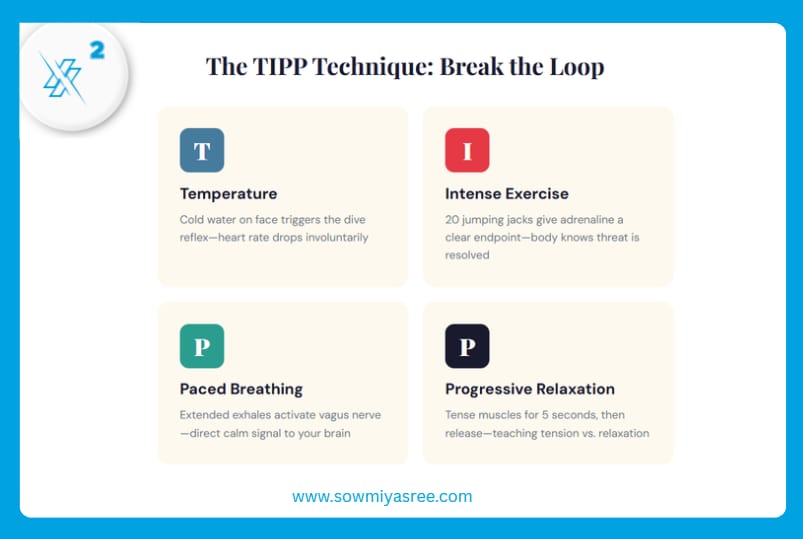
T - Temperature
Splash cold water on your face. Hold ice cubes. Take a cold shower.
Why it works: Cold temperature triggers the "dive reflex"—your body's evolutionary response to cold water immersion. Heart rate drops immediately. It's involuntary. You can't override it.³
I - Intense Exercise
20 jumping jacks. Sprint up stairs. Do burpees. Anything that spikes your heart rate deliberately.
Why it works: You're giving your body a task that requires the same chemical activation (adrenaline, increased heart rate) but with a clear endpoint. When you stop, your body knows the "threat" is resolved.
P - Paced Breathing
Slow, controlled exhales. We'll dive deep into this in a moment.
Why it works: Direct activation of the vagus nerve, your body's main "calm down" signal.
P - Progressive Muscle Relaxation
Tense each muscle group for 5 seconds, then release. Start with your fists, move through your body.
Why it works: You're teaching your body the difference between tension and relaxation. After holding tension deliberately, the release feels more profound.
These aren't distractions. They're physiological circuit breakers.
Each one sends a direct signal to your vagus nerve: "The threat has passed. Stand down."
The Missing Component That Makes DBT Work Faster: Breathwork
Here's what I've discovered through my research into breath science:
DBT skills work. But when you add specific breathing patterns, the results accelerate dramatically.
Why?
Because breathwork directly activates your parasympathetic nervous system—the biological brake pedal for emotional arousal.⁵
What Happens When You're Angry:
Your body enters a predictable state:
- Heart rate: 100+ bpm
- Breathing: Rapid, shallow, chest-based
- Blood pressure: Elevated
- Nervous system state: Sympathetic (fight/flight)
- Vagal tone: Low (your "calm down" nerve is offline)
Traditional advice says "take a deep breath."
But that's not specific enough. Not all breathing calms you down.
The Breathing Pattern That Actually Works: Extended Exhale
Extended exhale breathing reverses the anger state in under two minutes by shifting vagal tone:
The Pattern:
- Inhale for 4 counts (through nose)
- Exhale for 6-8 counts (through nose or mouth)
That's it.
But here's why the ratio matters:
That longer exhale stimulates the vagus nerve, which sends a direct signal to your brain: "We're safe. Reduce cortisol. Lower heart rate. Disengage threat response."⁴
The Science Behind the Extended Exhale:
Your vagus nerve runs from your brainstem down through your chest and abdomen. When you exhale slowly, you:
- Activate the parasympathetic nervous system (rest and digest mode)
- Increase heart rate variability (a marker of nervous system flexibility)
- Reduce cortisol levels (the stress hormone that keeps you activated)
- Lower blood pressure naturally
- Signal safety to your amygdala
The inhale activates your sympathetic nervous system slightly. The exhale activates your parasympathetic nervous system more strongly.
When your exhale is longer than your inhale, you tip the balance toward calm.
How to Combine DBT and Breathwork: The Fastest Reset
Here's the protocol I use when I feel anger escalating:
Step 1: Acknowledge (5 seconds)
Say to yourself: "This is anger. It will peak in 90 seconds if I don't retrigger it."
This simple acknowledgment engages your prefrontal cortex (thinking brain) instead of letting your amygdala (emotional brain) run the show.
Step 2: Choose One TIPP Technique (30-60 seconds)
Pick whichever is most accessible in the moment:
- Cold water on face (bathroom nearby?)
- 20 jumping jacks (private space available?)
- If neither is practical, go straight to breathwork
Step 3: Extended Exhale Breathing (2-3 minutes)
- Inhale through nose: 1-2-3-4
- Exhale through nose or mouth: 1-2-3-4-5-6-7-8
- Repeat for 10-15 cycles
Focus on the exhale. Make it smooth, controlled, complete.
Step 4: Body Scan (30 seconds)
Notice what's changed:
- Is your jaw less clenched?
- Are your shoulders lower?
- Is your heart rate slower?
This reinforces the learning: "I have a tool that works."
Real-World Applications: When to Use This
This technique isn't just for explosive anger. It works for:
- Frustration building during a difficult conversation
- Irritation with your kids/partner that's escalating
- Road rage (pull over first!)
- Work conflicts that are hijacking your afternoon
- Anticipatory anger (replaying yesterday's argument)
- Anxiety with an anger component (frustrated you can't control your worry)
What This Looks Like in Practice:
Scenario 1: Work Email
You read an email that feels dismissive. You start crafting a heated response.
→ Pause. Acknowledge: "I'm triggered. 90-second rule."
→ Stand up, splash cold water on face (20 seconds)
→ Extended exhale breathing (2 minutes)
→ Now respond (you'll write something you won't regret later)
Scenario 2: Parenting Moment
Your child spills juice for the third time today. You feel rage rising.
→ Acknowledge: "Anger. 90 seconds."
→ Step outside, do 20 jumping jacks (45 seconds)
→ Extended exhale breathing (2 minutes)
→ Return calmer, handle the situation
Scenario 3: Relationship Conflict
Your partner says something that hits a nerve. You want to yell.
→ Say: "I need 3 minutes" (leave the room)
→ Cold water on face
→ Extended exhale breathing
→ Return to conversation (now you can actually hear their perspective)
Why "Just Calm Down" Doesn't Work (But This Does)
When someone tells you to "just calm down," what they're really saying is: "Stop having the physiological response you're having."
But you can't.
You can't think your way out of a chemical flood.
You need a physiological intervention for a physiological problem.
That's why TIPP + breathwork is so effective:
- TIPP interrupts the immediate activation
- Breathwork sustains the downregulation
- Together, they give your prefrontal cortex time to come back online
DBT gives you the framework. Breathwork gives you the biological reset button.
Common Mistakes When Trying to Regulate Anger
Mistake 1: Deep Breathing Without the Extended Exhale
Random deep breaths can actually increase arousal if you're inhaling more than you're exhaling. The ratio matters.
Mistake 2: Trying to "Think" Your Way Out
Your prefrontal cortex is offline during peak anger. Logic won't work until you've calmed your nervous system first.
Mistake 3: Suppressing vs. Regulating
Suppression: "I'm not angry" (while still physiologically activated)
Regulation: "I'm angry AND I'm managing my response"
Mistake 4: Waiting Too Long
The earlier you intervene in the anger curve, the easier it is. Don't wait until you're at peak rage.
Mistake 5: Judging Yourself for Being Angry
Anger is information. It tells you something matters to you. The goal isn't to never feel angry—it's to not let anger control your behavior for hours.
Key Takeaways: Breaking Free from the Anger Loop
Your body processes anger in 90 seconds. Your mind keeps it alive for hours.
Here's what to remember:
✓ Emotions have a natural 90-second lifespan—it's the mental replay that extends them
✓ Your amygdala can't distinguish real threats from remembered ones
✓ TIPP techniques (Temperature, Intense exercise, Paced breathing, Progressive muscle relaxation) interrupt the physiological loop
✓ Extended exhale breathing (4-count inhale, 6-8 count exhale) activates your vagus nerve
✓ You need a physiological solution for a physiological problem
✓ The earlier you intervene, the faster you regulate
✓ This is a skill you can practice and improve
The next time anger hits—and it will, because you're human—you'll know exactly what to do.
Acknowledge it. Choose TIPP. Breathe with intention.
90 seconds becomes 2 minutes becomes done.
Not suppressed. Not avoided. Actually processed.
Frequently Asked Questions About the 90-Second Rule
Is the 90-second rule scientifically proven?
Yes. Dr. Jill Bolte Taylor's research as a neuroanatomist showed that the physiological cascade of emotion-related chemicals (cortisol, adrenaline, norepinephrine) peaks and clears in approximately 90 seconds if not retriggered by continued thought.
Why does my anger last longer than 90 seconds?
Because you're mentally replaying the triggering event. Each replay sends fresh chemical signals to your body, restarting the 90-second timer. You're recreating the emotional response through thought.
What is DBT and why does it work for anger?
DBT (Dialectical Behavior Therapy) was created by Dr. Marsha Linehan for people who experience intense emotions. Unlike traditional therapy that focuses on changing thoughts, DBT teaches practical skills to tolerate and regulate emotions without making them worse.
Does the extended exhale breathing technique work for anxiety too?
Yes. Extended exhale breathing activates the parasympathetic nervous system, which calms both anger and anxiety. The same vagal nerve activation that reduces anger also reduces anxious arousal.
How long should I practice extended exhale breathing?
For acute anger or anxiety, 2-3 minutes (10-15 breath cycles) is usually sufficient. For deeper regulation or ongoing stress management, you can extend to 5-10 minutes.
Can I use TIPP techniques in public?
Yes. Cold water on wrists (bathroom), brief intense movement (stairs, walking fast), and breathing are all discreet. You don't need to explain what you're doing.
What if TIPP and breathing don't completely eliminate my anger?
The goal isn't elimination—it's regulation. You're reducing intensity from a 9/10 to a 5/10, which is enough to make rational decisions. Complete elimination often takes longer and sometimes isn't necessary.
Is it normal to feel angry multiple times a day?
Yes. Anger is a normal human emotion and an important signal that something matters to you. The skill is in managing your response, not in never feeling angry.
Want to Go Deeper?
──────────────
- Why Breathing Less Can Calm You More: The Science of CO2-Optimized Breathing
- 4-4-8 vs 4-7-8 Breathing: Which Sleep Method Actually Works?
- Transform Your Daily Commute: Breathing Techniques for Stress-Free Travel
──────────────
References
- Taylor, J.B. (2008). My Stroke of Insight: A Brain Scientist's Personal Journey. New York: Viking Press. Available at drjilltaylor.com
- Linehan, M.M. (1993, 2015). Cognitive-Behavioral Treatment of Borderline Personality Disorder and DBT Skills Training Manual (2nd ed.). New York: Guilford Press. Learn more about DBT
- Gooden, B.A. (1994). Mechanism of the human diving response. Integrative Physiological and Behavioral Science, 29(1), 6-16. DOI: 10.1007/BF02691277 https://pubmed.ncbi.nlm.nih.gov/8018553/
- Porges, S.W. (2011). The Polyvagal Theory: Neurophysiological Foundations of Emotions, Attachment, Communication, and Self-regulation. New York: W.W. Norton & Company. Polyvagal Theory resources
- Jerath, R., Crawford, M.W., Barnes, V.A., & Harden, K. (2015). Self-regulation of breathing as a primary treatment for anxiety. Applied Psychophysiology and Biofeedback, 40(2), 107-115. DOI: 10.1007/s10484-015-9279-8 https://doi.org/10.1007/s10484-015-9279-8
Additional Research Sources
- Goleman, D. (1995). Emotional Intelligence: Why It Can Matter More Than IQ. New York: Bantam Books. (Amygdala hijack concept)
- Kox, M., van Eijk, L.T., Zwaag, J., et al. (2014). Voluntary activation of the sympathetic nervous system and attenuation of the innate immune response in humans. Proceedings of the National Academy of Sciences, 111(20), 7379-7384. https://doi.org/10.1073/pnas.1322174111
- Brown, R.P., & Gerbarg, P.L. (2005). Sudarshan Kriya yogic breathing in the treatment of stress, anxiety, and depression. Journal of Alternative and Complementary Medicine, 11(4), 711-717. https://api.semanticscholar.org/CorpusID:43190322
Recommended Resources:
- Behavioral Tech: What is DBT?
- The Linehan Institute
- Dr. Jill Bolte Taylor's Official Site
- DBT Self-Help Resources
- Polyvagal Theory and emotional regulation
Written by Sowmiya Sree | a Breath Researcher & Author on a series of topics related to Breath
This article is thoroughly researched and fact-checked using peer-reviewed studies and trusted medical resources. Last updated: January 2026
Note: This article is for informational purposes only and does not constitute medical advice. Always consult your healthcare provider for medical concerns
Photo by Олег Мороз on Unsplash