Research published in the Journal of Clinical Psychology found that while 46% of people maintain resolutions for six months, the drop-off is steep—nearly one-third of all failures happen before the end of January².
But here's what the research doesn't tell you: the problem isn't your willpower. It's your nervous system.
Your body doesn't recognize January 1st as a reset. Your nervous system doesn't care about resolutions, meal prep plans, or gym memberships.
It responds to one signal louder than any other—breath.
And if you don't change how you breathe while trying to change everything else, your body will keep running last year's patterns no matter what the calendar says.
Quick 5-Point Summary
- Why resolutions fail when they fight your biology (not willpower)
- The ancient biological signal your nervous system actually recognizes
- How breath creates measurable nervous system regulation
- The 1-minute morning breath ritual backed by neuroscience
- Why 60 seconds is enough to signal "today starts differently"
Table of Contents
──────────────
Why Most New Year's Resolutions Fail (The Biology of Burnout)
The Signal Your Nervous System Actually Recognizes
What Happens When You Change Goals Without Changing Breath
The 1-Minute Morning Breath Ritual
The Science: Why 60 Seconds Is Enough
Key Takeaways
Frequently Asked Questions
Want to Go Deeper?
References
──────────────
Why Most New Year's Resolutions Fail (The Biology of Burnout)
The statistics are clear: nearly 80% of people abandon their goals within weeks.²
Researchers have blamed poor planning or a lack of discipline.
Neuroscience confirms this: you're trying to change behavior without regulating the system that controls it.
Your nervous system.
For nearly 300,000 years, humans didn't mark time with calendars. We tracked survival through biological signals: light and darkness, hunger and fullness, danger and safety.
And always, breathe.
When a threat appeared, breath quickened, activating the sympathetic nervous system for fight or flight. When safety returned, breath softened, signaling the parasympathetic system to rest and restore.
That ancient system still lives in you.
Which is why your body doesn't automatically feel renewed just because the date changed. It's still running the same patterns from last year:
- Shallow chest breathing during emails
- Breath-holding during stressful decisions
- Unconscious tension you carry without realizing it
Modern life asks us to change everything at once, sleep schedules, food habits, routines, goals, without ever changing how we breathe while doing it.
This mismatch is why so many people feel already exhausted, already tense, already discouraged by the end of January.
Nothing is wrong with you. Your body is simply ancient.
The Signal Your Nervous System Actually Recognizes
If calendars don't work, what does?
A 2018 review in Frontiers in Psychology³ confirmed that slow breathing is one of the most effective ways to modulate the autonomic nervous system, the part of your body that regulates stress, heart rate, digestion, and emotional state.
Researchers found that:
- Fast, shallow breathing keeps the sympathetic (stress) system dominant
- Slow, controlled breathing activates the parasympathetic (rest) system
- Exhale extension creates the strongest safety signal
Your nervous system doesn't respond to New Year's intentions. It responds to repeated physiological signals.
How Your Body Learns "Today Is Different"
Studies show that consistent breathing practices create measurable changes in nervous system function. Even brief periods of slow breathing can increase vagal tone, your body's resilience to stress, within minutes.⁴
One minute of conscious breathing, repeated every morning, creates what neuroscientists call "state-dependent learning"—your body begins associating morning with regulation rather than reactivity.
That's the biological signal your nervous system needs to recognize that something is actually different.
What Happens When You Change Goals Without Changing Breath
Most New Year's resolutions fail not because of lack of willpower, but because the nervous system never got the memo.
Example scenario:
You set an alarm for 6 AM, bought a meal prep kit, downloaded a meditation app, and promised yourself, this year will be different', but you're still doom-scrolling in bed with shallow chest breathing.
- Shallow, chest-dominant breathing while scrolling your phone in bed
- Breath-holding while rushing through your morning routine
- Rapid breathing while mentally planning your day
Your body interprets this as: "Same stress. Same threat level. Same survival mode."
So even though you're "doing all the right things," your nervous system is running the same dysregulated pattern.
This is why people feel exhausted by their own goals.
The actions changed. The breath didn't.
The 1-Minute Morning Breath Ritual
Instead of starting this year by pushing forward, start by regulating inward.
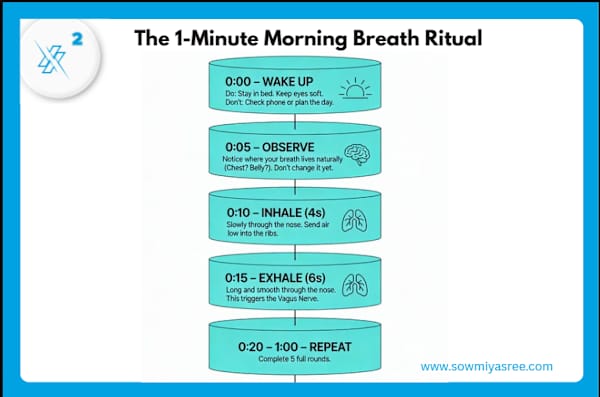
The Practice:
Before anything else—before checking your phone, before your feet hit the floor:
Step 1: Notice your natural breath (don't change it yet—just observe where it lives)
Step 2: Inhale slowly through your nose (4 seconds)
Step 3: Exhale fully through your nose (6 seconds)
Step 4: Repeat for 5 rounds (approximately 1 minute total)
That's it. One minute. 365 mornings.
No app. No tracking. No pressure. Just you and the body you'll live in all year.
The Science: Why 60 Seconds Is Enough
You might wonder: Can one minute really matter?
Yes. Here's why:
Reason 1: Vagal Tone Activation
Slow, controlled breathing stimulates the vagus nerve, the primary highway between your brain and body for calm signals.
Research shows that even brief periods of slow breathing can measurably increase vagal tone, your body's built-in stress resilience system.⁴
Translation: One minute tells your body, "We're safe. We can function from calm, not chaos."
Reason 2: Pattern Interruption
Most people wake up and immediately activate their stress response, checking notifications, mental task lists, rushing.
One minute of conscious breath interrupts that automatic cascade before it begins.
You're not adding more to your morning. You're changing the signal your body receives first.
Reason 3: State-Dependent Learning
By practicing this every morning, you create a biological anchor. Your body begins associating waking up with regulation rather than reactivity.
This isn't about perfection. It's about pattern. Your nervous system responds to repetition, not intensity.
Reason 4: CO₂ Tolerance and Oxygen Efficiency
Extended exhales (6 seconds) help optimize CO₂ levels in your bloodstream, which improves oxygen delivery to cells and reduces the sensation of air hunger throughout the day.⁵
This creates a calmer baseline breathing pattern that persists beyond the practice itself.
Key Takeaways
- Resolutions fail when goals fight biology; your nervous system doesn't recognize calendar dates
- 300,000 years of evolution wired your body to respond to respiratory signals, not New Year's intentions
- One minute of conscious breathing creates a biological pattern your nervous system recognizes as "today starts differently."
- Studies show slow breathing activates vagal tone and parasympathetic regulation within minutes
- Consistency matters more than intensity; daily practice creates lasting nervous system change
- You don't need to add more habits; you need to regulate the system running all your habits
Two ways to continue this journey
1. Need instant relief?
Get my "60-Second Miracle" guide (PDF) for free. It contains 5 science-backed breathing techniques for instant calm, focus, pain relief, and better sleep.
👉 Download the Free Miracle Guide
2. Ready to master your biology?
My book collection offers the complete roadmap. From sleep architecture to emotional resilience, these manuals teach you how to permanently rewire your response to stress through the power of breathwork.
👉 Browse the Book Collection
Frequently Asked Questions
Why don't New Year's resolutions work for most people?
Research shows nearly half of people fail to maintain resolutions beyond six months.¹ The problem isn't willpower—it's that people try to change behavior without regulating the nervous system that controls it. Your body doesn't recognize calendar dates. It responds to physiological cues, primarily breath. Without changing how you breathe, your nervous system continues running last year's stress patterns.
Can one minute of breathing really make a difference?
Yes. Research shows even brief slow breathing measurably increases vagal tone—your body's stress resilience system.⁴ The key is consistency. One minute activates your parasympathetic (rest) nervous system and interrupts automatic stress responses. When repeated daily, your body begins associating morning with regulation rather than reactivity.
Do I have to do this first thing in the morning?
First thing matters. Your nervous system sets its baseline tone within the first few minutes of waking. If you check your phone first, you've already activated stress pathways. One minute of breath before anything else interrupts that pattern and signals that today starts differently.
What if I forget some mornings?
Start the next morning. Your nervous system tracks pattern, not perfection. Missing one day doesn't erase progress. Consistency over weeks matters more than perfection over days. Even 5 days a week creates meaningful biological change.
Want to Go Deeper?
──────────────
Morning Breathing Exercises: A Science-Backed Alternative to Coffee for Natural Energy
The Weird 4-Second Trick That Eliminates Afternoon Fatigue Almost Instantly
4-4-8 vs 4-7-8 Breathing: Which Sleep Method Actually Works?
──────────────
References:
- Kok, B. E., & Fredrickson, B. L. (2010). Upward spirals of the heart: Autonomic flexibility, as indexed by vagal tone, reciprocally and prospectively predicts positive emotions and social connectedness. Biological Psychology, 85(3), 432–436. https://doi.org/10.1016/j.biopsycho.2010.09.005
- Norcross, J. C., Mrykalo, M. S., & Blagys, M. D. (2002). Auld lang syne: Success predictors, change processes, and self-reported outcomes of New Year's resolvers and nonresolvers. Journal of Clinical Psychology, 58(4), 397–405. https://doi.org/10.1002/jclp.1151
- Oscarsson, M., Carlbring, P., Andersson, G., & Rozental, A. (2020). A large-scale experiment on New Year's resolutions: Approach-oriented goals are more successful than avoidance-oriented goals. PLOS ONE, 15(12), e0234097. https://doi.org/10.1371/journal.pone.0234097
- Zaccaro, A., Piarulli, A., Laurino, M., Garbella, E., Menicucci, D., Neri, B., & Gemignani, A. (2018). How breath-control can change your life: A systematic review on psycho-physiological correlates of slow breathing. Frontiers in Human Neuroscience, 12, 353. https://doi.org/10.3389/fnhum.2018.00353
Written by Sowmiya Sree | a Breath Researcher & Author on a series of topics related to Breath
This article is thoroughly researched and fact-checked using peer-reviewed studies and trusted medical resources. Last updated: January 2026
Note: This article is for informational purposes only and does not constitute medical advice. Always consult your healthcare provider for medical concerns