8 min read
At a Glance
How do microplastics enter the lungs through breathing, and what can you actually do about it? Microplastics are now present in indoor air, in your home, car, and kitchen, and research suggests the average person may inhale tens of thousands of particles daily. Studies have physically recovered microplastic particles from human lung tissue, where they appear associated with inflammation and airway disruption. You cannot eliminate exposure entirely, but specific kitchen, textile, and ventilation habits can meaningfully reduce it.
In this article, you'll discover:
- How many microplastic particles you may be inhaling each day and where they end up
- What studies have found when examining actual human lung tissue
- The ordinary household habits that are your highest-exposure windows
- What nasal breathing and breathwork can — and cannot — do about microplastics?
- Specific, practical changes ranked by the evidence behind them
Table of Contents
The Number You Can't Unsee
- One particle every 1.3 seconds
- Your car is worse than your home
What Research Found Inside Human Lungs
- Particles recovered from lung tissue
- What microplastics appear to do once inside
Where It's Coming From
- Synthetic textiles
- Plastic kitchen habits
- Traffic and road proximity
- Indoor dust
What Breath Practice Can — and Cannot — Do
What Actually Reduces Exposure
- Kitchen changes
- Textiles and laundry
- Indoor air quality
- Your car
Key Takeaways
Frequently Asked Questions
Conclusion
Related Articles
References
-------------------
Last week I was unwrapping a cheese slice for my son's sandwich when I paused. Am I giving him nutrition, or something else?
Research suggests the plastic around our food isn't staying there. It's already in the air we breathe and, remarkably, inside human lungs.
You can't see it. You can't taste it. But with every breath you take indoors, at home, in your car, in your kitchen, you are likely inhaling microplastics.
The Number You Can't Unsee
One particle every 1.3 seconds
A 2022 University of Toulouse study measured microplastic concentrations in apartments and cars. Their finding: the average person may inhale around 68,000 microplastic particles every day.¹
That works out to roughly one particle every 1.3 seconds while you're awake.
Over 94% of those particles are smaller than 10 micrometers, small enough to bypass your upper airways and reach the alveoli, where oxygen crosses into your blood.¹
Your car is worse than your home
The same research measured 2,238 particles per cubic meter inside cars, compared to 528 in apartments.¹ Your daily commute is one of your highest-exposure windows, a detail worth noting if you've been thinking about microplastics only in terms of water bottles.
If you've read about how breathing during your commute affects your nervous system, this adds another dimension to that conversation: the air quality inside the vehicle matters too.
What Research Found Inside Human Lung Tissue
Particles recovered from lung tissue
This isn't speculative. Studies have physically recovered microplastics from human lungs.
One study examining samples from 11 patients found microplastic particles across multiple polymer types.² Polypropylene, common in food packaging and clothing fibers, appeared most frequently, followed by PET from water bottles and polyester fabric.
A separate analysis found that lung tissue had the highest microplastic concentration of any organ tested, higher than the intestine, tonsil, or other sites sampled.¹ The researchers noted this may reflect the lungs' large surface area and constant air flow, which gives airborne particles direct and repeated access.
What microplastics appear to do once inside
Once deposited, microplastics don't simply sit inert. Research suggests they may degrade the protective mucous lining of airways and trigger inflammatory responses, specifically, stimulating cytokines including IL-6 and TNF-α.³
They may also act as carriers. Microplastics can adsorb pesticides, heavy metals, and bacteria, potentially delivering these compounds directly into alveolar tissue.³
Because the lungs provide such a large surface area for gas exchange, inhaled microplastics also appear capable of entering the bloodstream. Research has since detected microplastics in human blood, cardiac tissue, and brain tissue, though the mechanisms and health implications of these findings are still under active investigation.⁴
Current research has associated microplastic lung exposure with respiratory conditions including asthma, COPD, pulmonary fibrosis, and lung cancer.⁵ Scientists are still working to establish exact causal mechanisms; what exists now is association evidence, not proven causation.
Where It's Coming From
The sources are ordinary, which is part of why this is difficult to think about.
Synthetic textiles
Synthetic clothing sheds microfibers continuously, particularly during machine washing and drying. Fleece, polyester, and acrylic release fibers into both water and air. These fibers accumulate in household dust and are inhaled when disturbed.
Plastic kitchen habits
Heat accelerates plastic degradation. Reheating food in plastic containers, running plastic items through hot dishwasher cycles, and storing food in plastic wrap. particularly frozen items that go directly from freezer to microwave. are among the higher-risk habits.⁶
Traffic and road proximity
Synthetic rubber tire dust stays suspended in air and is a significant contributor to outdoor microplastic concentrations. Studies have observed that individuals living within 300 meters of a main road show measurably higher microplastic levels in lung tissue.¹
If you spend time outdoors near traffic, or if your home ventilation draws from street-facing windows, this is worth considering alongside the indoor sources.
Indoor dust
Household dust accumulates microfibers from textiles, packaging, and synthetic furnishings. Dry sweeping re-suspends these particles back into breathing air rather than removing them, an important distinction for cleaning approach.
What Breath Practice Can — and Cannot — Do
This is worth being precise about, because the answer is more nuanced than either dismissing breath practice or overstating its role.
Conscious breathing will not remove microplastics from lung tissue once they're deposited. There is no breathwork technique that clears particles that have already reached the alveoli.
What nasal breathing does offer is better upstream filtration. The nasal passages, with their mucous membranes, cilia, and turbinate structures, filter larger airborne particles more effectively than mouth breathing allows. If you're already breathing nasally, you're giving your body its best available defense at the point of entry.⁷
If you've explored nose breathing versus mouth breathing in terms of oxygen efficiency and nitric oxide production, microplastic filtration adds one more meaningful reason to default to nasal breathing during everyday activity.
Regular diaphragmatic breathing, the kind that maintains full lung expansion, also supports healthy ventilation patterns. Well-ventilated lungs may be better positioned to clear deposited particles through normal mucociliary transport. But this is general respiratory health maintenance, not a targeted intervention for microplastic removal.
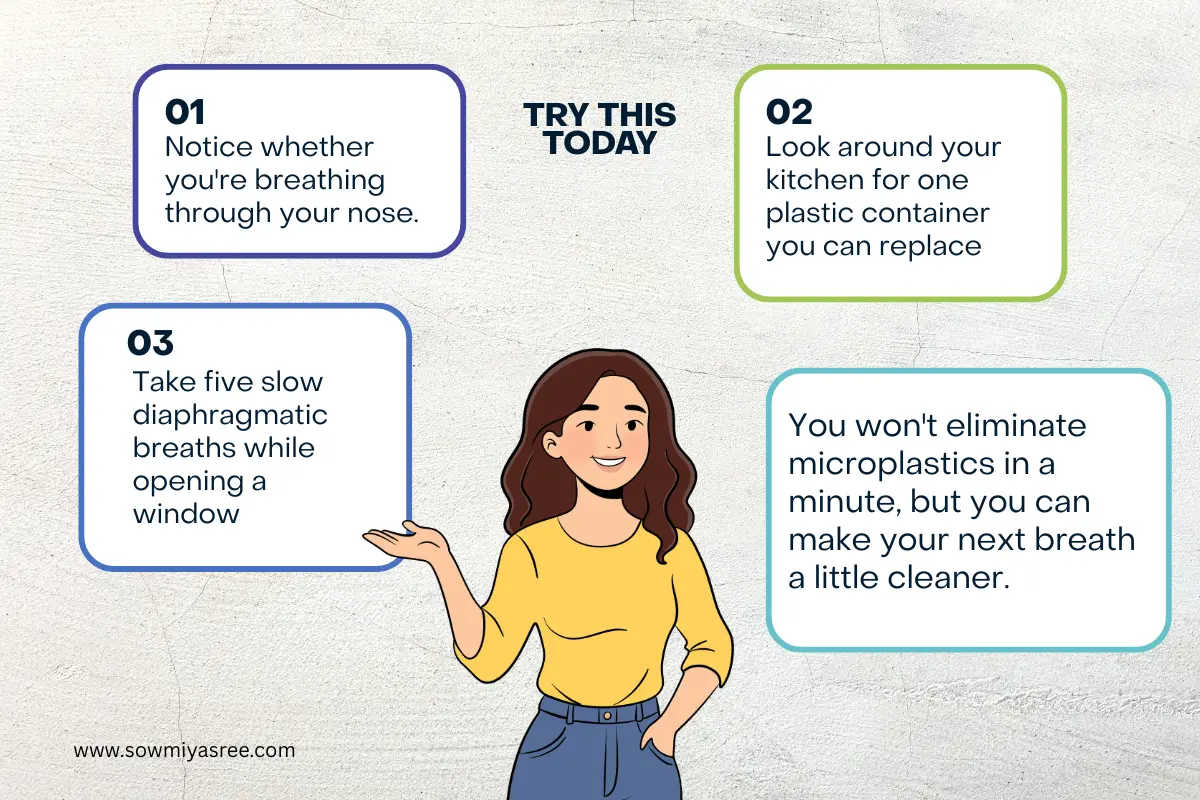
The honest framing: breath practice is still worth doing. It just works alongside reducing exposure, not instead of it.
What Actually Reduces Exposure
You cannot eliminate microplastic inhalation entirely. But the research points to specific categories of habits where reduction is both practical and meaningful.
Kitchen changes
Heat and plastic are the highest-risk combination. The practical changes:
- Stop reheating food in plastic containers, transfer to glass, ceramic, or stainless steel first
- Move frozen food out of plastic packaging before thawing, rather than microwaving in the original container
- Replace plastic water bottles with glass or stainless steel for daily use
- Avoid running plastic items through hot dishwasher cycles when hand washing is feasible
Textiles and laundry
- Wash synthetic fabrics less frequently when clothing isn't soiled
- Use a microfiber-catching laundry bag (such as a Guppyfriend bag) to trap fibers before they reach drainage and indoor air
- Ensure dryer ventilation exhausts fully to the outside rather than recirculating air
- Prioritize natural fibers: cotton, linen, wool, for bedding and items in primary living spaces where you spend extended time
Indoor air quality
- Run a HEPA air purifier in rooms where you spend the most time, particularly the bedroom (where you spend 7–8 hours) and kitchen
- Wet mop hard floors instead of dry sweeping, wet mopping captures particles rather than re-suspending them
- Vacuum with a HEPA-filter vacuum rather than standard models that expel finer particles back into air
If improving your breathing environment is already on your radar, HEPA filtration serves double duty, it addresses both seasonal air quality and microplastic particle load.
Your car
- Use air recirculation mode to prevent drawing in high-particulate outside air during commutes
- Replace the cabin air filter on schedule, this is your primary mechanical defense against the elevated particle concentrations found inside vehicles
- Allow the car to air out briefly before entering after it has been parked in direct sun, which can accelerate off-gassing from interior plastics
Key Takeaways
- Research suggests the average person may inhale approximately 68,000 microplastic particles per day, with in-car exposure significantly higher than in-home exposure.¹
- Studies have physically recovered microplastics from human lung tissue, where they appear associated with inflammatory responses and may act as carriers for additional compounds. ¹,²,³
- Nasal breathing provides better upstream filtration than mouth breathing, but no breathwork technique removes microplastics already deposited in lung tissue.
- The highest-leverage reduction habits are kitchen (eliminating heat + plastic combinations), indoor air (HEPA filtration, wet mopping), textiles (synthetic fiber reduction), and vehicle maintenance (cabin filter replacement).
- Current evidence shows association between microplastic lung exposure and respiratory conditions; causal mechanisms remain under active investigation. This warrants attention, not alarm, but it does warrant action.
Frequently Asked Questions
Are microplastics actually dangerous, or is this being overstated?
The honest answer is: the full picture is still forming. What is established is that microplastics are present in human lung tissue, blood, and other organs, and that they appear to trigger inflammatory responses in airway tissue.³ Association data links exposure to respiratory conditions. Causal mechanisms are still being worked out. This places microplastics in the category of 'warranting precautionary action' rather than either dismissal or alarm.
Does breathing through my nose actually help?
Yes, for particles large enough to be filtered by nasal anatomy. The nasal passages use mucous membranes, cilia, and turbinate structures to trap airborne particles more effectively than mouth breathing allows.⁷ This is meaningful filtration. but it's less effective for the smallest particles (under 2.5 micrometers) that can bypass nasal filtration regardless of breathing route.
What's the single highest-impact change I can make?
Based on the available evidence, eliminating the heat-plus-plastic combination in your kitchen offers meaningful and immediate reduction. Microwaving food in plastic containers, reheating in plastic bowls, and running plastic through hot dishwasher cycles all accelerate plastic degradation and increase particle release.⁷ Switching to glass or stainless steel for these specific uses addresses your highest-exposure food preparation window.
Should I be worried about my child's exposure?
Children's developing respiratory systems may be more susceptible to the effects of inhaled particles, and they typically spend more time indoors. The practical priorities are the same as for adults, HEPA filtration in living and sleeping spaces, natural fiber bedding, and eliminating plastic-plus-heat kitchen habits, but they're more urgent for children's environments.
Do air purifiers actually work for microplastics?
HEPA (High Efficiency Particulate Air) filters are designed to capture particles down to 0.3 micrometers with very high efficiency. Most microplastic particles in indoor air fall within the size range that HEPA filtration can meaningfully address. Activated carbon filters target gases and volatile compounds, useful for other indoor air concerns but not for particle removal specifically.
Can microplastics leave the lungs once inhaled?
Some microplastics are cleared through mucociliary transport, the body's natural mechanism for moving mucus and trapped particles up and out of the airways. Smaller particles that reach the alveoli may be taken up by immune cells (macrophages) or may cross into the bloodstream.⁴ There is no established intervention that accelerates clearance of particles that have already been deposited at depth.
Does this mean I should stop exercising outdoors?
No. The cardiovascular and respiratory benefits of regular exercise are well-established and significant. If you run outdoors, choosing routes away from heavy traffic where possible is sensible, and breathing through your nose during low-to-moderate intensity exercise provides better filtration than mouth breathing. But reducing microplastic exposure is not a reason to avoid physical activity.
Conclusion
Science is still mapping the full picture of microplastic health effects. But what's already established is enough to act on, not with alarm, but with attention.
The heat-plus-plastic habits in your kitchen. The synthetic dust in unventilated rooms. The cabin filter you haven't replaced. These are not abstract environmental concerns, they're specific, changeable features of your daily breathing environment.
We often think of pollution as something that exists outside our homes. Increasingly, research suggests it may be settling quietly in our kitchens, our cars, and our lungs.
You can't control every breath you take. But you can control many of the choices that shape the air around you.
One breath-aware action for this week: replace one plastic food container with glass or stainless steel. That's where the evidence is clearest, and where the change is most immediate.
Related Articles
Transform Your Daily Commute: Breathing Techniques for Stress-Free Travel
Nose Breathing vs Mouth Breathing: Why Your Breathing Technique Matters
Why Winter Air Makes Breathing Harder (And How to Breathe Easier)
Lung Asymmetry: Why Your Right and Left Lungs Are Intentionally Different
What Does Shortness of Breath on Stairs Mean?
References
- Jenner, L. C., Rotchell, J. M., Bennett, R. T., Cowen, M., Tentzeris, V., & Sadofsky, L. R. (2022). Detection of microplastics in human lung tissue using μFTIR spectroscopy. Science of the Total Environment, 831, 154907. https://doi.org/10.1016/j.scitotenv.2022.154907
- Amato-Lourenço, L. F., Carvalho-Oliveira, R., Ribeiro Júnior, G., dos Santos Galvão, L., Ando, R. A., & Mauad, T. (2021). Presence of airborne microplastics in human lung tissue. Journal of Hazardous Materials, 416, 126124. https://pubmed.ncbi.nlm.nih.gov/34492918/
- Wright, S. L., & Kelly, F. J. (2017). Plastic and human health: A micro issue? Environmental Science & Technology, 51(12), 6634–6647. https://doi.org/10.1021/acs.est.7b00423
- Leslie, H. A., van Velzen, M. J. M., Brandsma, S. H., Vethaak, A. D., Garcia-Vallejo, J. J., & Lamoree, M. H. (2022). Discovery and quantification of plastic particle pollution in human blood. Environment International, 163, 107199. https://doi.org/10.1016/j.envint.2022.107199
- Prata, J. C., da Costa, J. P., Lopes, I., Duarte, A. C, Duarte, A. C., & Rocha-Santos, T. (2020). Environmental exposure to microplastics: An overview on possible human health effects. Science of the Total Environment, 702, 134455. https://doi.org/10.1016/j.scitotenv.2019.134455
- Sobhani, Z., Lei, Y., Tang, Y., Wu, L., Zhang, X., Naidu, R., Megharaj, M., & Fang, C. (2020). Microplastics generated when opening plastic packaging. Scientific Reports, 10, 4841. https://doi.org/10.1038/s41598-020-61146-4
- Eccles, R. (2000). Nasal airflow in health and disease. _Acta Otolaryngologica_, _120_(5), 580–595. https://pubmed.ncbi.nlm.nih.gov/11039867/
Enjoyed this article?
Join The Breath Brief for twice-monthly research-backed stories on breathing, physiology, and health. https://sowmiyasree.com/mailing-list
About the Author
Written by Sowmiya Sree | Breath Science Writer & Author
This article is thoroughly researched and fact-checked using peer-reviewed studies and trusted medical resources.
Last updated: June 2026
Medical Disclaimer
This article is for informational purposes only and does not constitute medical advice. Information about microplastic health effects represents an active and evolving area of research; findings cited here reflect the current state of evidence, not settled consensus. Do not use this article to self-diagnose or self-treat any respiratory or medical condition. Always consult qualified healthcare professionals for medical evaluation and care.
Photo by CareyHope @canava