8 min read
At a Glance
Can inhalers affect your teeth? Yes, inhalers and oral health are connected because some inhaled medications reduce saliva, lower the mouth's pH, and leave residue behind, which can raise the risk of dry mouth, tooth decay, and oral thrush. These effects are manageable with good technique and routine dental care, and they are not a reason to stop a prescribed inhaler.
In this article, you'll discover:
- Why medicine meant for your lungs can still reach your teeth and gums
- What research actually shows about inhalers, dry mouth, cavities, and oral thrush
- Simple, dentist-backed habits that protect your mouth without touching your treatment
- How your own breathing pattern — nose versus mouth — quietly shapes your oral health
Table of Contents
────────────────────────────────────────────────────────
How Can an Inhaler Reach Your Teeth and Gums?
Do Inhalers Cause Dry Mouth?
Can Inhalers Cause Oral Thrush?
Can Inhalers Cause Cavities or Enamel Erosion?
How Can You Protect Your Teeth If You Use an Inhaler?
Does the Way You Breathe Affect Your Oral Health Too?
Should You Stop Using Your Inhaler to Protect Your Teeth?
Key Takeaways
Frequently Asked Questions
Conclusion
────────────────────────────────────────────────────────
We usually picture a breathing treatment working in exactly one place: the lungs. An inhaler opens the airways. A nebulizer delivers medication. Breathing gets easier, and that is where our attention tends to stop.
But breath never works in isolation. The air, and often the medication carried with it, travels through the mouth on the way down. That single detail is why inhalers and oral health are more connected than most people realize. If you or someone you love uses an inhaler or nebulizer for asthma, COPD, or another respiratory condition, where changes in how you breathe, such as accessory breathing in COPD, are already part of daily life, this is worth understanding. Not to create fear, but to trade worry for awareness.
None of what follows means your inhaler is "bad for you." It means one treatment can help one part of the body while asking for a little attention in another.
How Can an Inhaler Reach Your Teeth and Gums?
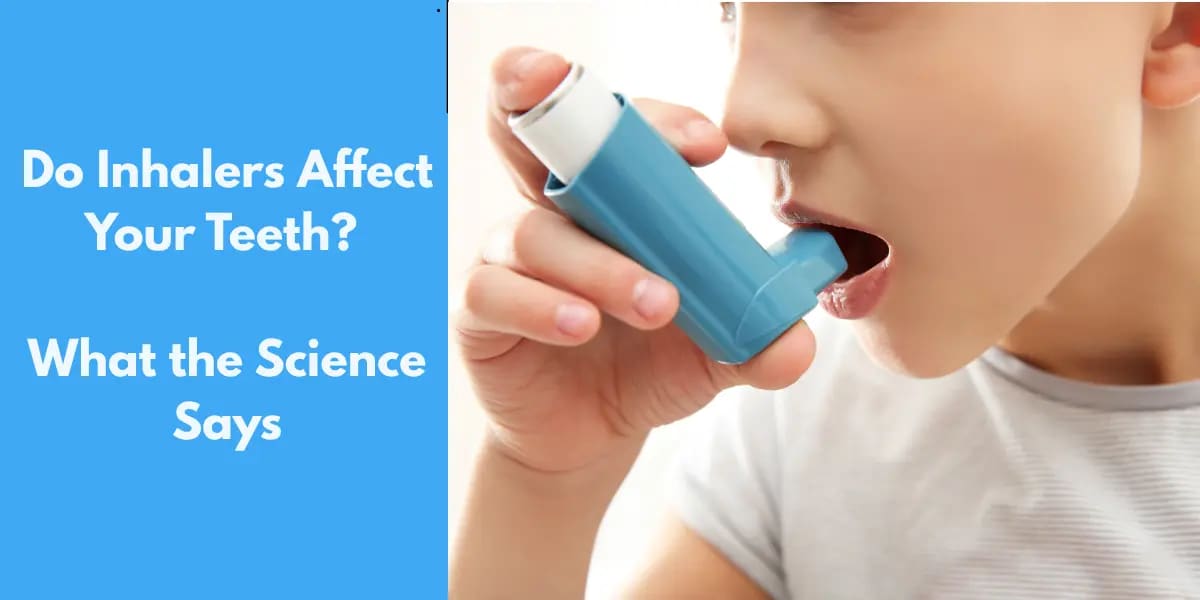
An inhaler is aimed at your lungs, but your mouth is the doorway. A meaningful fraction of the medicated aerosol settles on your teeth, gums, tongue, and the lining of your mouth before, or instead of, reaching the airways.
Even with good technique, not every particle of an inhaled dose makes it to the lungs. A meaningful fraction is deposited in the mouth and throat, which is why local oral effects occur in the first place. Pacheco-Quito et al. (2023) note that this oropharyngeal deposition is the mechanism behind most of the mouth-related side effects of inhaled therapy, and that spacer devices help by reducing how much drug lands on oral tissues.
For someone managing a chronic condition, an inhaler is not a one-time event, it is a daily habit, sometimes several times a day, for years. Small exposures repeated over time are what make the oral environment worth paying attention to.
Do Inhalers Cause Dry Mouth?
Some inhaled medications can reduce how much saliva your mouth produces. Because saliva buffers acids and helps defend your teeth, less of it leaves your mouth more vulnerable to decay and irritation.
Saliva is not just moisture. It is your mouth's built-in rinse: it washes away food, neutralizes acids, and carries protective proteins that keep bacteria in check. When it drops, those defenses drop with it.
Pacheco-Quito et al. (2023) report that prolonged use of β2-adrenergic agonists, the "reliever" medications in many inhalers, is associated with a reduction of roughly 36% in the secretion rate of the parotid salivary gland, along with lower levels of protective salivary components such as amylase, peroxidase, lysozyme, and IgA. In practical terms, a drier mouth (xerostomia) can mean more decay, more discomfort, and more bad breath over time. Staying hydrated and using sugar-free gum to stimulate saliva are simple counter-measures.
Can Inhalers Cause Oral Thrush?
Yes. Inhaled corticosteroids, the "preventer" inhalers, can raise the risk of oral thrush (candidiasis), a fungal infection that appears as white patches or soreness. Medication left behind in the mouth is a key reason.
In a large prescription sequence-symmetry analysis, van Boven et al. (2013) found that the risk of oral candidiasis nearly doubled after people began an inhaled corticosteroid (sequence ratio 1.94, 95% CI 1.71–2.21). The risk was highest in the first three months of use (sequence ratio 2.72) and rose with higher daily doses, an association, not proof of cause in any single person, but a consistent and dose-related pattern.
Reported prevalence varies widely across studies, from essentially none to as high as 77% of inhaled-corticosteroid users, and, reassuringly, oral mucosal immunity tends to normalize once the steroid is discontinued (Pacheco-Quito et al., 2023). Thrush is treatable, and good inhaler technique plus rinsing after use meaningfully lowers the risk.
Can Inhalers Cause Cavities or Enamel Erosion?
They can contribute. Some inhaled formulations lower the mouth's pH, and combined with reduced saliva, that leaves teeth with fewer defenses against decay and erosion.
Enamel begins to demineralize when the mouth's pH falls below roughly 5.5. Pacheco-Quito et al. (2023) report that some anti-asthmatic inhalers can push oral pH below that critical threshold, with the drop occurring within about 30 minutes of inhalation, and that patients using salbutamol inhalers showed a higher risk of carious lesions than non-asthmatic peers. Part of the effect is chemical (acidity), and part is compositional, some formulations contain fermentable carbohydrates and are linked to higher counts of the cavity-causing bacterium Streptococcus mutans.
There is also an indirect route: β2-agonists can relax the lower esophageal sphincter, which may increase acid reflux and add to the acid load on teeth (Pacheco-Quito et al., 2023). A useful habit: because enamel is temporarily softened after an acid exposure, rinse with water first and wait before brushing rather than brushing immediately.
How Can You Protect Your Teeth If You Use an Inhaler?
The good news: several simple habits can help protect your mouth without changing your treatment, rinse your mouth after steroid inhalers, use a spacer, stay hydrated, and keep your dentist informed.
Both van Boven et al. (2013) and Pacheco-Quito et al. (2023) emphasize patient education and inhaler technique as the front line of defense. A few practical steps:
- Rinse and spit after inhaled corticosteroids. Swish water (or brush) after using a steroid inhaler to clear residue, ask your clinician whether this is appropriate for your specific medication.
- Use a spacer. A spacer directs more medication to the lungs and less onto oral tissues.
- Keep regular dental check-ups, and tell your dentist everything. Inhalers and nebulizers included, it changes how they monitor and advise you.
- Notice the early signs. Persistent dry mouth, white patches, soreness, bad breath, or changes in your teeth or gums are worth flagging.
- Never stop a respiratory medicine on your own. If an ongoing oral problem develops, talk to your doctor or dentist rather than quietly abandoning the treatment that keeps you breathing.
Does the Way You Breathe Affect Your Oral Health Too?
Yes. Beyond any medication, chronic mouth breathing dries the mouth by increasing evaporation, while nasal breathing helps keep it protected, so how you breathe, hour after hour, shapes your oral environment.
Here is the part that fascinates me most as a breath researcher: your medication is not the only thing shaping your mouth. Your breathing pattern is, too. Kaur et al. (2018) measured that habitual mouth breathers lose about 42% more water from the oral environment than nose breathers, a genuinely drier mouth, produced by behavior rather than a drug.
That dryness appears to matter for the tissues themselves. In the same study, gum-healing outcomes after deep cleaning were poorer at the palatal sites of mouth breathers: 69% of deep pockets returned to health in nose breathers versus 38% in mouth breathers (Kaur et al., 2018). This is an association observed in one clinical sample, not proof that mouth breathing causes gum disease, but the functional overlap with medication-related dryness is worth noting.
In other words, the drying that an inhaler can cause has a behavioral cousin. If you'd like to understand your own default pattern, see nose breathing versus mouth breathing, and for how oral-facial habits shape the airway itself, how soft foods can quietly narrow your airway. Nasal breathing, by keeping the mouth from being continuously bathed in airflow, is one small structural way to protect the same tissues an inhaler asks you to watch.
Should You Stop Using Your Inhaler to Protect Your Teeth?
No. A side effect is information, not an instruction to stop. The goal is to keep breathing well while managing the oral effects, and decisions about medication belong with your doctor and dentist.
This is where my pharmacy training tends to speak up. We often ask, "Is this medicine good or bad?", but that is usually the wrong question. Effective medicines can have unwanted effects. The better question is: what is this medicine helping me with, what should I watch for, and how can I manage those effects safely?
Think about levocetirizine, commonly used for allergy symptoms. It can cause drowsiness in some people. We don't simply say, "Don't take it." Instead, we understand the possible effect and take precautions, being careful about driving, for instance, and following professional advice. The same logic holds here. If a breathing treatment contributes to dry mouth or another oral concern, the answer is rarely to abandon what is helping you breathe. The answer is awareness: tell your doctor, tell your dentist, notice what is happening in your body, and care for the lungs and the mouth together.
Better health often begins with noticing a connection we didn't know was there. If you want to build that habit of noticing, start with conscious breath awareness.
Breathe. Notice. Ask questions. Take care.
Key Takeaways
- Inhaled medication reaches the mouth. Because a portion of every dose deposits on oral tissues, inhalers and oral health are genuinely linked (Pacheco-Quito et al., 2023).
- Three effects to know: reduced saliva/dry mouth (about a 36% drop in parotid secretion with β2-agonists), oral thrush (nearly doubled risk after starting inhaled corticosteroids), and a more acidic, decay-prone mouth (pH below 5.5).
- The fixes are simple: Rinse after steroid inhalers, use a spacer, hydrate, and tell your dentist, no need to stop treatment.
- Your breathing pattern counts too. Chronic mouth breathing produces roughly 42% more oral water loss than nasal breathing (Kaur et al., 2018).
- A side effect is information. Manage it in partnership with your doctor and dentist, never by silently stopping a prescribed medicine.
Frequently Asked Questions
Can inhalers cause cavities?
They can contribute to cavity risk. Some inhaled formulations lower oral pH below the ~5.5 threshold where enamel demineralizes, and reduced saliva removes a natural defense; salbutamol users have shown higher rates of carious lesions than non-asthmatic peers (Pacheco-Quito et al., 2023). Rinsing after use and regular dental care substantially reduce the risk.
Can you get oral thrush from an inhaler?
Yes , inhaled corticosteroids can raise the risk of oral thrush (candidiasis), which shows up as white patches or soreness. Starting an inhaled corticosteroid nearly doubled candidiasis risk in one large analysis, with the risk highest in the first three months (van Boven et al., 2013). It is treatable, and rinsing plus a spacer lowers the likelihood.
Should I rinse my mouth after using my inhaler?
For inhaled corticosteroids, Rinse and spit after use is a widely recommended way to clear residue and reduce thrush and decay risk. Confirm with your clinician whether it applies to your specific medication, since not all inhalers carry the same effects.
Do all inhalers affect teeth the same way?
No. "Reliever" β2-agonists are more associated with reduced saliva and acidity, while "preventer" corticosteroids are more associated with oral thrush. Many people use both, so the practical habits, rinsing, spacers, hydration, dental check-ups, cover the range.
Can nebulizers affect oral health like inhalers?
The same principle applies: medication delivered through the mouth can leave residue and dry the tissues, so similar precautions are sensible. Discuss technique and after-care with your clinician, and mention nebulizer use to your dentist alongside any inhalers.
Will the oral effects go away if I stop the inhaler?
Some effects, such as steroid-related shifts in oral immunity, tend to normalize after the medication is discontinued (Pacheco-Quito et al., 2023), but stopping a respiratory medicine on your own can be dangerous. Manage oral side effects with your doctor and dentist rather than by quitting treatment.
Conclusion
A breathing treatment does its most important work in the lungs, but it passes through the mouth to get there, and that passage leaves a mark worth understanding. Inhalers and oral health are linked through three manageable effects: dry mouth, oral thrush, and a more acidic, decay-prone environment. None of them is a reason to stop a medicine that keeps you breathing.
The path forward is awareness, not alarm. Rinse after steroid inhalers, use a spacer, stay hydrated, keep your dentist in the loop, and pay attention to how you breathe the rest of the day. Care for the lungs and the mouth together, and let a side effect be what it truly is: information that helps you manage your health more wisely.
Related Articles
- Nose Breathing vs Mouth Breathing: Why Your Breathing Technique Matters
- Accessory Breathing in COPD: What It Is, Why It Happens, and How to Manage It
- How Soft Foods Are Silently Narrowing Your Airway
- Spotting Your Breathing Habits: A Complete Guide to Conscious Breath Awareness
Reference List
- Kaur, M., Sharma, R. K., Tewari, S., & Narula, S. C. (2018). Influence of mouth breathing on outcome of scaling and root planing in chronic periodontitis. BDJ Open, 4, 17039. https://doi.org/10.1038/s41405-018-0007-3
- Pacheco-Quito, E.-M., Jaramillo, J., Sarmiento-Ordoñez, J., & Cuenca-León, K. (2023). Drugs prescribed for asthma and their adverse effects on dental health. Dentistry Journal, 11(5), 113. https://doi.org/10.3390/dj11050113
- van Boven, J. F. M., de Jong-van den Berg, L. T. W., & Vegter, S. (2013). Inhaled corticosteroids and the occurrence of oral candidiasis: A prescription sequence symmetry analysis. Drug Safety, 36(4), 231–236. https://doi.org/10.1007/s40264-013-0029-7
About the Author
Written by Sowmiya Sree | Breath Researcher & Author
This article was reviewed against peer-reviewed research and trusted medical resources.
Last updated: September 2026
Medical Disclaimer
This article is for informational purposes only and does not constitute medical or dental advice. Inhalers, nebulizers, and corticosteroids are prescription treatments with individual risks and benefits; the oral effects described here vary by medication, dose, and person. Do not start, stop, or change any prescribed respiratory medication on your own. Always consult qualified healthcare and dental professionals for evaluation and care.
Photo credit Pixelshot @ Canva